
AI innovations in 2024–2025 are disrupting long-established consulting models. The rapid advancement of AI tools and workflows has upended the consulting industry’s status quo. Traditional consulting firms—once prized for exhaustive research and polished slide decks—are now facing existential pressure to evolve. Clients have realized that generative AI can synthesize data and create insights in minutes, not months, often matching the quality of expensive consultant analyses. In this climate, a new breed of AI automation agencies is emerging. These fast-moving teams leverage AI and automation to deliver done-for-you solutions with unprecedented speed, continual iteration, and tangible results, challenging the very role of traditional consultants in the future of work.
AI Disruption in Consulting (2024–2025)
Recent data shows that the consulting industry is already being transformed by AI. In mid-2024, McKinsey disclosed that about 40% of its client projects now involve AI, with nearly 500 organizations seeking AI-related consulting in the past year. This surge in automation projects has provided a lifeline for consulting firms amid a slump in demand for traditional strategy engagements. Major firms like McKinsey, PwC, and EY have even cut jobs in old-line service areas while doubling down on AI-focused divisions. McKinsey’s own tech arm (QuantumBlack) grew to 2,000 specialists, and firm leaders envision a future with “one AI agent for every human employee” as they deploy thousands of AI assistants internally.
Crucially, clients are driving this change. Executives have begun to question paying for “a suit with PowerPoint” deliverables when AI can generate similar analyses and slide decks instantly. As the CEO of Oliver Wyman noted, companies today demand hands-on implementation, not just fancy reports. In response, top consultancies are pivoting: McKinsey says 40% of its revenues now come from tech and AI solutions, and ~25% of its projects use outcomes-based pricing (payment for results rather than billable hours). In effect, the line between consultant and tech provider is blurring.
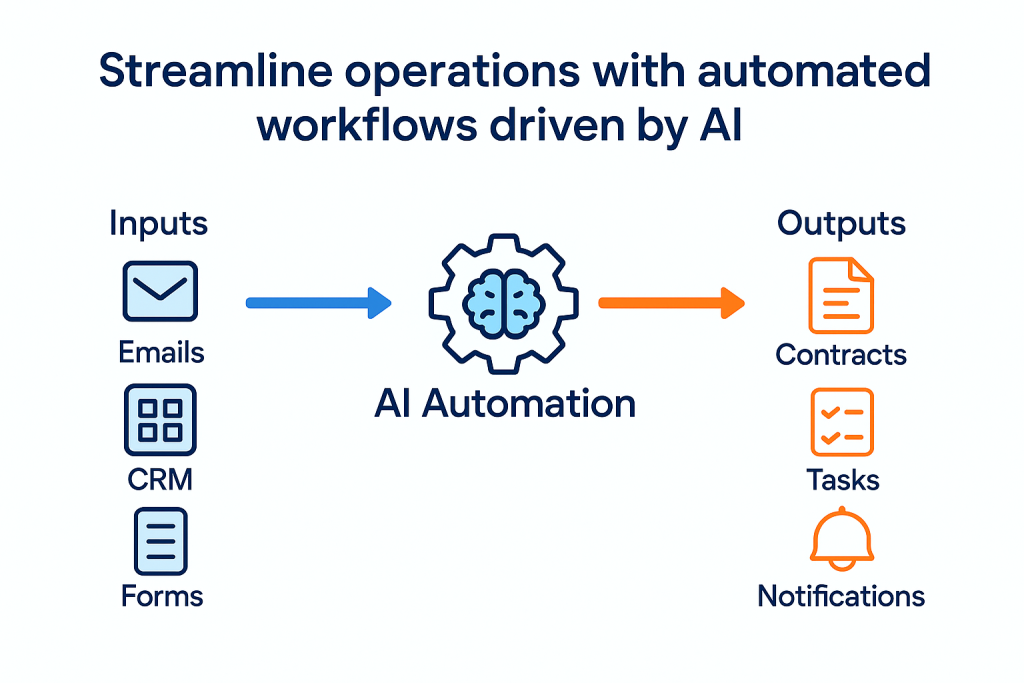
This upheaval is not just anecdotal—it’s reflected in industry forecasts. Gartner analysts predict that by 2026, 20% of large organizations will use AI to flatten management structures, eliminating over half of current middle-management roles (Gartner press release). That means fewer layers of hierarchy coordinating work—some responsibilities of junior analysts and project managers are simply being automated. In banking, Citi researchers foresee AI automating up to 54% of jobs across that sector’s operations. And looking broader, the World Economic Forum’s Future of Jobs 2025 report estimates 170 million new jobs will be created by AI and automation by 2030, even as 92 million traditional roles are displaced (WEF overview). In other words, huge workforce shifts are underway: many routine analytical and coordination tasks will be handled by AI, while new human roles emerge in AI oversight, strategy, and innovation. Traditional consulting, which often relied on armies of junior staff for research and analysis, is directly in the crosshairs of these trends.
Leaner, Faster, Smarter: The Rise of AI Automation Agencies
Enter the AI automation agency – a new consulting paradigm built for this age of intelligent tools. These agencies differ from legacy consulting firms in several fundamental ways:
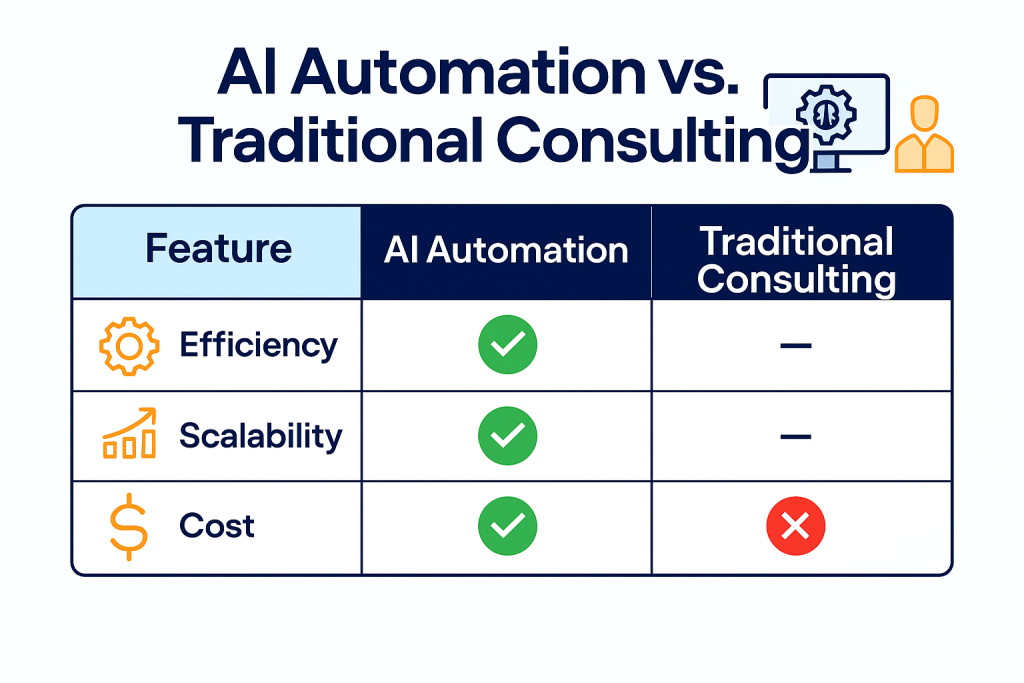
- Lean Teams vs. Big Pyramids: Traditional consultancies operate a pyramid structure with many junior analysts at the base. In contrast, AI automation agencies run lean. A small team of senior problem-solvers armed with AI can do what dozens of junior consultants did before. For instance, McKinsey found that project teams which once required 14 consultants can now operate with just 2–3 consultants plus AI agents supporting them. This lean model not only cuts cost; it also means clients work directly with experienced experts instead of paying to train a gaggle of fresh MBAs.
- Technical Mastery vs. Slide Deck Expertise: Rather than churning out slides, automation agencies focus on building and deploying technology. Their consultants are often prompt engineers, developers, and process automation specialists who know how to wring value from AI APIs, RPA (robotic process automation), and low-code tools. They spend more time crafting AI prompts, refining models, and integrating systems than polishing PowerPoint. The result? Instead of a 100-page report, the deliverable might be a working AI-driven dashboard or an automated workflow pipeline ready to use. Clients increasingly prefer this — as Nick Studer of Oliver Wyman observed, companies want “implementation, not just advice”.
- Speedy Iteration vs. Months-Long Studies: Old-school consulting projects often take months of interviews, analysis, and review before recommendations are delivered. AI agencies work in an agile, iterative fashion. They might spin up a proof-of-concept in a week, demonstrate a tangible result, then refine it through rapid cycles. Using generative AI, they can quickly prototype solutions (e.g. an AI chatbot or an automated reporting tool) and improve it on the fly. This speed is possible because AI dramatically accelerates knowledge work – for example, research that took analysts weeks can often be done by an AI in hours or less. As one Deloitte study noted, 74% of organizations report their most advanced AI initiatives are meeting or exceeding ROI expectations, proving that quick, focused deployments can deliver value if done right (Deloitte 2024)..
- Outcome-Focused vs. Hourly Billing: Automation-centric firms tend to price based on outcomes and value delivered, not on time spent. Given AI can compress work that used to take 100 hours into 10 hours, the old billable hour model makes little sense. Many automation agencies offer fixed-fee packages or success fees tied to metrics (e.g. a percentage of cost savings achieved or revenue growth). Even the big consultancies are moving this way — about a quarter of McKinsey’s work is now under outcome-based contracts rather than hourly billing. This aligns incentives with the client’s results, not the consultant’s hours, and it’s enabled by confidence that technology can reliably drive measurable improvements.
- “Done For You” Solutions vs. Recommendations: Perhaps the biggest difference is in the deliverables. A traditional consultant might analyze a client’s customer service and recommend implementing a chatbot; an automation agency would likely build and launch the chatbot for you. These agencies specialize in done-for-you automation – they don’t stop at telling you what to do, they actually do it. For example, if a small e-commerce retailer is losing sales to abandoned shopping carts, a consulting firm might produce a report on strategies to improve conversions. An AI automation agency, on the other hand, could implement an AI-driven abandoned cart recovery system within days. In one case, a boutique automation team set up a sequence of AI-driven email and Messenger reminders, recovering $4,500 in lost sales (a 28% boost in conversions within 30 days) for a small retail clienta. Similarly, rather than advising a professional services firm on lead qualification, an AI agency might deploy an online AI-powered quiz funnel that automatically filters and nurtures leads. (One consulting coach saw this approach yield 580 new leads and book $8,000 in consultations with minimal manual effort.) The motto of these agencies could well be: ship the MVP first, refine later. Clients get a tangible solution in hand quickly, which can then be fine-tuned, instead of waiting months for analysis with no implementation.
Why Businesses Are Embracing Automation Agencies
For many organizations—especially small businesses and startups—these differences aren’t just theoretical; they translate into real competitive advantage. In a 2025 survey of 1,000 small businesses, 82% of owners said adopting AI is essential to stay competitive in today’s market (Reimagine Main Street). Yet over half admitted they lack the time, skills, or clarity on how to do it (Reimagine Main Street). This is exactly where AI automation agencies fit in: they provide the expertise and execution to bridge that gap quickly.
Consider the needs of a lean startup or a mid-size enterprise operations team. They are often resource-constrained and cannot afford lengthy consulting projects that yield only slide decks. What they need is rapid solutions to pressing operational problems—whether it’s automating invoice processing, deploying a generative AI to handle routine HR queries, or optimizing a supply chain with predictive analytics. Automation agencies, with their ability to parachute in a small expert team, deploy a solution in weeks, and iterate, are a perfect match for this agile mindset. They function as an on-demand “AI SWAT team” that can deliver quick wins and then scale them.
Another reason businesses are turning to these agencies is the explosive growth in accessible AI tools. By 2025, an astounding 88% of companies worldwide report using AI in at least one business function (up from 78% just a year prior)(McKinsey – State of AI). The barrier to entry for AI has lowered, but maximizing its value still requires specialized know-how. Many firms dabble with tools like ChatGPT or robotic automation, but struggle to integrate them deeply or scale beyond pilot projects. Indeed, McKinsey’s latest Global AI Survey finds nearly two-thirds of organizations are still stuck in experimentation mode and haven’t fully scaled AI across the enterprise (McKinsey – Global AI Survey). The bottleneck often is not the technology itself, but a lack of strategy, talent, or confidence to deploy it more broadly. Automation agencies provide that missing link—packaged “AI as a service” capability. They offer pre-built frameworks, experienced practitioners, and proven use-case playbooks that accelerate the journey from pilot to production.
Critically, these agencies are outcome-driven, so they align their work to concrete business KPIs. A traditional consultant might deliver a strategy for, say, improving manufacturing efficiency and then depart, leaving the client to execute. An automation agency would aim to automate parts of the manufacturing process outright—for instance, integrating AI vision inspection on the factory line or an IoT-driven analytics system—and directly tie their fees to the efficiency gains achieved. This focus on results resonates strongly with business owners in 2024–2025, who are navigating economic uncertainties and need clear ROI. In fact, a Deloitte study in late 2024 noted that 75% of surveyed organizations increased their investments in generative AI during the year, but also that most are carefully tracking ROI and scaling only where value is proven (Deloitte 2024). The message: companies are eager to invest in AI, but they want fast, tangible impact. Automation agencies, by design, cater to that mentality.
Finally, there’s a cultural shift at play. The rising generation of business leaders is more tech-native and impatient with the old ways of working. They’re often less impressed by a fancy 50-page report (that might sit on a shelf) than by a scrappy prototype that they can touch and feel. As Inc. put it: “Clients no longer want consultants just to analyze data or produce reports—they can get AI to do that. They want partners who will help implement and drive outcomes.”(inc.com). In other words, the value of outside advisors is now judged by their ability to augment the client’s team and get things done, not just advise. This is exactly the niche that AI automation specialists fill, and why they’re increasingly seen as the future of consulting rather than the big legacy firms.
Adapting to the New Reality: Consultants and AI in Harmony
Does the rise of AI automation agencies spell the end of traditional consulting? Not entirely. Instead, it’s forcing a reinvention of consulting roles and skills. The best traditional firms are already adopting a hybrid approach—investing billions in AI capabilities, partnering with tech providers, and retraining their armies of MBAs to work alongside AI. For example, KPMG announced a $2 billion alliance with Microsoft to infuse AI across its audit, tax, and advisory services (KPMG press release).
Accenture is investing $3 billion to double its AI workforce to 80,000 specialists (Accenture press release). All of the “Big Four” now have initiatives to integrate AI assistants into their client work, whether it’s for automating due diligence or generating first drafts of strategy reports.
Moving forward, we can expect a convergence: Traditional consulting firms will try to become more like tech firms, and boutique automation agencies will grow and broaden their advisory capabilities. In fact, industry experts predict entirely new forms of consulting organizations could dominate within a decade. These might be flatter, productized consulting companies that sell AI solutions bundled with expert services. The common denominator is that AI is embedded in the core workflow. The consultants of the future—whether at a big firm or a small agency—will be those who excel at bridging human expertise with AI capabilities. As McKinsey’s Kate Smaje put it, parts of consulting will remain “tough to automate” – like navigating organizational politics, building consensus, and driving cultural change. Human consultants will still shine in those areas. But the baseline expectation is shifting: clients assume that data-crunching, research, and even initial solution prototyping will be turbocharged by AI. Any consulting practice not leveraging these tools will be left behind, much as any business not leveraging AI risks uncompetitiveness.
For individual consultants and small consulting shops, this is actually an opportunity. The playing field is being leveled by technology. A two-person AI-savvy team can now credibly compete for projects against a behemoth firm, because they can lean on powerful AI platforms to extend their reach. Indeed, we’re already seeing “AI-first consulting” startups win contracts from large corporate clients. These upstarts differentiate themselves by being flexible, cost-effective, and deeply technical. They often have industry veterans partnering with AI engineers, combining domain knowledge with cutting-edge tech skills. Their pitch is simple: we’ll get it done faster and cheaper using AI. And in many cases, they do—forcing larger consultancies to respond in kind.
Ready for the Next Step? (Call to Action)
The takeaway for business leaders is clear: AI automation is no longer a future idea, but a present-day reality in the world of work. If you’re a small business owner, operations manager, or startup founder, you don’t have to navigate this transformation alone—or wait months for traditional advice. Agile AI automation agencies can help you identify high-impact automation opportunities and implement them rapidly. It starts with a conversation about your processes and pain points.
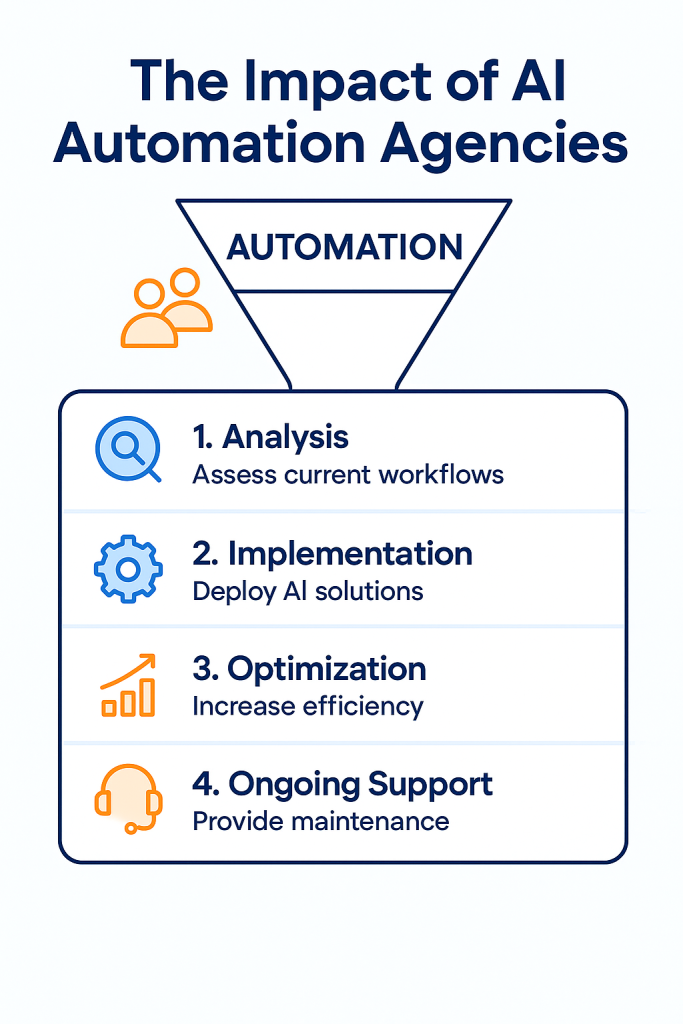
Imagine unlocking hours of productivity by automating tedious tasks, or delighting your customers with AI-driven responsiveness, all without having to hire a large team or spend a fortune on consulting fees. Our agency specializes in exactly that. We offer an “AI Automation Audit” to pinpoint immediate wins in your business where AI and automation could drive efficiency or growth. We’ll then craft a tailored roadmap – and crucially, help build the solution for you, whether it’s a custom AI integration, a workflow automation, or a data-driven decision tool.
👉 Book a Consultation / Automation Audit: Ready to explore how AI can transform your operations? Contact us today to schedule a free consult. In a 30-minute call, we’ll assess your needs and show how a done-for-you AI solution can deliver results within weeks, not months. The future of work belongs to those who adapt quickly. Let us help you harness the power of AI now, so you can lead in this new era of intelligent automation. Your competitors are experimenting with these tools – don’t get left behind. Embrace the change and position your organization at the forefront of innovation.
Sources
Gartner (2024): Top Predictions for IT Organizations and Users in 2025 and Beyond — Press release
World Economic Forum (2025): AI’s impact on jobs: displacement vs. creation by 2030 — Overview
Deloitte (2024): State of Generative AI in the Enterprise — Report
McKinsey (2025): The State of AI: Global Survey — Report
Accenture (2023): $3B investment to expand AI capabilities — Press release
KPMG + Microsoft (2023): $2B AI alliance — Press release

 using WordPress and
No responses yet